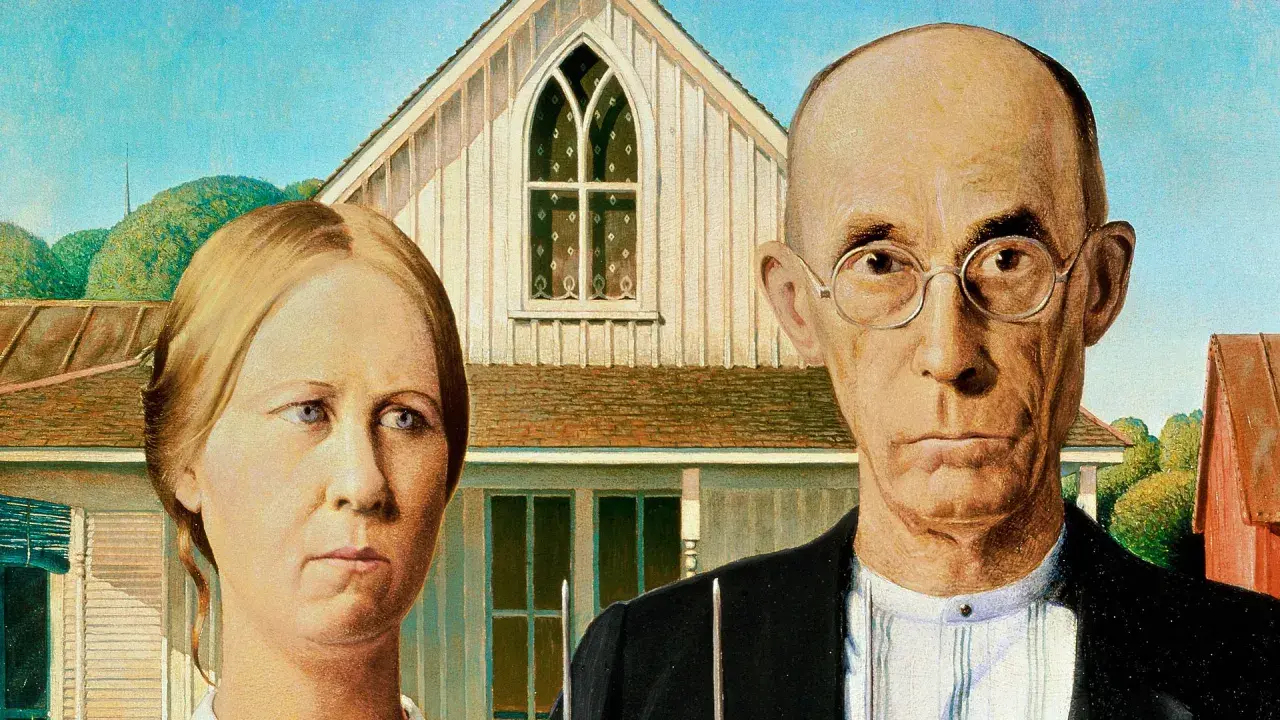
The image is more ambiguous than the nickname suggests
- Grant Wood painted American Gothic in 1930, using oil on beaverboard.
- The standard interpretation is a farmer and his daughter, not a husband-and-wife pair.
- The title refers to the Carpenter Gothic style of the house, not simply to rural life.
- The work is a landmark of Regionalism, with a distinctly Midwestern view of American identity.
- Its fame comes from the tension between seriousness, restraint, and irony.
- The painting is housed in the Art Institute of Chicago and remains one of the most parodied images in art.
What painting people usually mean by this phrase
The phrase farmer and his wife painting usually points to Grant Wood’s American Gothic, one of the most recognisable images in American art. It was painted in 1930 and shows a stern-looking man holding a pitchfork beside a woman in a plain apron, standing in front of a small house with a sharply pointed window. The Art Institute of Chicago notes that Wood directly evoked an earlier generation by staging the figures in a way that feels deliberate, upright, and slightly severe.
That last point matters. This is not a casual rural snapshot. Wood built a visual idea of the Midwest, not a documentary scene, and that is why the painting still gets discussed as both a portrait of a time and a constructed statement about it. The title also misleads some readers at first: it refers to the house’s Gothic-style architecture, which helps explain why the image feels so compressed, formal, and symbolic rather than merely domestic.
Once you see that, the rest of the painting starts to make more sense. The work is less about one family than about how rural identity was imagined in the early 20th century, and that is where the real interest begins.
How the composition does so much with so little
What I find most effective in American Gothic is how disciplined the composition is. Every element is doing structural work. The pitchfork repeats the vertical line of the man’s body, the window behind them echoes their upright posture, and the house itself gives the whole scene a narrow, almost unforgiving frame. Nothing drifts. Nothing softens the image.
The clothing adds another layer. The man’s work clothes are topped with a jacket, while the woman’s apron suggests practicality but also formality. That mix is important because it prevents the picture from becoming a simple labour scene. Instead, it looks like a statement about values: restraint, duty, self-possession, and a certain stubborn seriousness.
Wood also relies on facial expression to hold the image together. Neither figure smiles. Neither looks warmly inviting. That refusal of easy sentiment is exactly why the painting remains compelling. It asks the viewer to decide whether the pair are resilient, judgmental, anxious, proud, or all of those at once. In art terms, that ambiguity is not a weakness; it is the engine of the image.
From here, the obvious next question is why this deliberately awkward little scene became such a cultural icon in the first place.
Why American Gothic became an icon
The painting arrived at a moment when the United States was under intense social and economic pressure, and that timing helped. Rural America was being reimagined in art, politics, and popular culture, and Wood’s image became one of the clearest examples of that shift. It fits within Regionalism, the movement that treated local American subjects as worthy of serious painting, but it also pushes beyond simple celebration.
There is a reason the image can feel affectionate in one viewing and biting in the next. The couple or pair looks solid, even admirable, yet the stiffness of the pose makes the scene slightly unnerving. That tension is exactly what gave the painting staying power. It can be read as a tribute to traditional values, a quiet satire of them, or something in between. I think that productive uncertainty is the real reason it outlasted many more obviously dramatic works from the same era.
It also became easy to reuse. Once an image is this clear in silhouette and attitude, it starts turning into shorthand. Posters, cartoons, advertisements, political jokes, and art parodies all found ways to borrow it. That repeatability says something important: the painting is not just famous because it is old, but because it is visually exact. It gives later artists and commentators a ready-made language for rural identity, authority, and discomfort.
That visibility, however, has also created a few persistent mistakes about what the picture actually shows.
What viewers often get wrong about the figures
The biggest misunderstanding is the relationship between the two figures. Many people casually call them husband and wife, but the commonly accepted reading is that the woman is the man’s daughter. The Art Institute of Chicago notes that Wood never fully shut down the ambiguity, which is one reason the error lingered in the public imagination. In practice, that uncertainty changes how you read the whole work.
| Common assumption | Better reading | Why it matters |
|---|---|---|
| It shows a farmer and his wife | It is usually read as a farmer and his daughter | The emotional tone shifts from marital tension to family authority and duty |
| It is a literal portrait | It is a staged, symbolic composition | The image becomes an argument about identity, not just a record of people |
| It is purely mocking | It sits between respect and irony | The painting’s ambiguity is what keeps it alive |
| It is only about farming | It is also about architecture, class, discipline, and cultural memory | The house and clothing are as important as the rural setting |
Another common error is to treat the image as a straightforward snapshot of farm life. It is not. The figures were modelled from people Wood knew, but the resulting painting is carefully assembled, almost theatrical. That distinction matters because it tells you how to describe the work accurately: as an interpreted scene, not an unfiltered one.
Once those misconceptions are cleared up, the final question is less about identity and more about relevance. Why does this image still feel current?
What this image still teaches in 2026
In 2026, American Gothic still matters because it shows how quickly an image can become a cultural code. The painting is old enough to be canonical, yet direct enough to survive meme culture, design reuse, and endless parody without losing its basic force. That is rare. Most famous paintings become decorative over time; this one still argues with the viewer.It also reminds us that rural imagery is never neutral. A farm house, a pitchfork, and a plain apron can suggest honesty, hardship, pride, rigidity, or all four at once. That complexity is why the painting remains useful in art writing and exhibition context. It gives critics a compact way to discuss regional identity, visual irony, and the line between admiration and critique.
If I were describing the work for a catalogue, I would keep it simple: Grant Wood, American Gothic, 1930, a staged portrait of Midwestern seriousness that is famous precisely because it is harder to pin down than it first appears. That is the cleanest answer to the farmer-and-wife shorthand, and it is also the most accurate one.